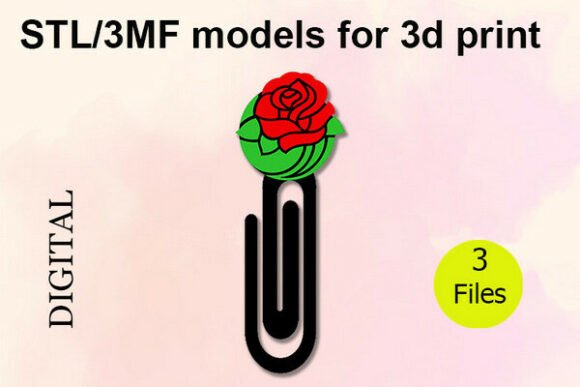
Elevating Stationery with 3D Printed Rose Paper Clips: A Guide to STL and 3MF Files
In the evolving intersection of digital fabrication and traditional analog hobbies, few items capture the imagination quite like functional art. The humble paper clip, once a purely utilitarian office supply, has been reimagined through the lens of additive manufacturing into something far more expressive. Specifically, the rose-shaped paper clip represents a perfect synthesis of botanical aesthetics and practical organization. For enthusiasts of journaling, scrapbooking, and planner communities, these small accessories offer a way to personalize everyday objects with elegance and charm.
Understanding how to acquire, print, and utilize these designs requires a basic grasp of 3D printing file formats and material considerations. Whether you are a seasoned maker with a multi-color setup or a beginner looking to print your first functional accessory, exploring the nuances of STL and 3MF files for rose paper clips opens up a world of creative stationery possibilities.
The Intersection of Function and Floral Aesthetics
Paper clips serve a fundamental purpose: holding documents together without damaging them. However, in the context of modern planning and journaling, their role has expanded beyond mere utility. They have become decorative anchors that signify sections, mark important dates, or simply add a tactile element of beauty to a page. The rose design is particularly significant because it bridges the gap between romantic sentimentality and structured organization.
For flower lovers and stationery fans, a standard metal wire clip can feel sterile against the warmth of handwritten notes or vintage-style scrapbook pages. A 3D printed rose clip introduces texture, color, and personality. It transforms a functional necessity into a lovely accessory for decorating books, notebooks, planners, invitations, or gifts. This shift reflects a broader trend in the maker community where technology is used not just to solve engineering problems, but to enhance emotional connection and personal expression in daily life.
Understanding Digital File Formats: STL vs. 3MF
When downloading digital products for 3D printing, understanding the difference between file types is crucial for achieving the best results. Most digital marketplaces provide files in specific formats tailored to different printer capabilities.
The Universal Standard: STL Files
The STL (Stereolithography) file is the industry standard for 3D printing. It contains only the geometric mesh of the model. When you download a zip file containing an STL for a rose paper clip, you are receiving the raw shape data. This format is compatible with virtually every type of 3D printer, from entry-level FDM machines to high-end resin printers.
However, STL files lack color information. If you print a rose STL on a standard single-nozzle printer, the result will be a monochromatic object. While this produces a clean design that is easy to print, it relies entirely on the filament color you load or post-processing techniques like painting to achieve visual variety. For beginners, the STL is often the best starting point because it eliminates the complexity of color mapping and allows focus on mastering layer adhesion and dimensional accuracy.
The Multi-Color Advantage: 3MF Files
The 3MF (3D Manufacturing Format) is a newer, more sophisticated container format that includes geometry, color, texture, and even print settings. For users with multi-color printers (such as those with AMS units or tool changers), 3MF files unlock the full potential of the rose paper clip design.
Digital products often include multiple 3MF variations to cater to different aesthetic preferences. One version may separate colors by layers, creating a striped or gradient effect throughout the print. Another version might restrict color changes solely to the top layer, allowing for a detailed, painted-on look while keeping the base structure uniform. Understanding these distinctions helps makers choose the right file for their specific hardware and desired outcome, ensuring the final product matches the elegant vision of the designer.
Design Considerations for Functional Prints
Printing a decorative statue is vastly different from printing a functional mechanical part. A paper clip must possess specific physical properties to work effectively. It needs enough flexibility to open without snapping, yet enough rigidity to hold paper securely. The rose paper clip models available in digital marketplaces are typically engineered with these constraints in mind.
A key feature of high-quality functional designs is the absence of required supports. Supports are temporary structures used during printing to prevent sagging, but they leave rough surface finishes and require tedious removal. A well-designed rose clip is modeled as a single solid piece oriented specifically for support-free printing. This not only saves material and time but also ensures the clip is smooth against delicate book pages and planner inserts. For both beginners and experienced makers, selecting models optimized for support-free printing significantly increases the success rate and usability of the final object.
Customization and Post-Processing
One of the greatest advantages of digital fabrication is adaptability. Unlike mass-produced plastic clips, 3D printed files can be freely scaled in your slicer software. If you are using a pocket-sized traveler’s notebook, you might scale the model down to 80% to maintain proportion. Conversely, for a large-format art journal or gift wrapping, scaling up to 150% creates a bold statement piece. This flexibility ensures the accessory fits perfectly within your specific organizational system.
Furthermore, the suitability of these files for different colors of plastic encourages experimentation. Beyond changing filament spools, makers can employ manual post-processing. Acrylic paints, alcohol inks, or metallic waxes can be applied after printing to add depth, shading, or a pearlescent finish that filament alone cannot achieve. This hybrid approach—combining digital precision with analog craftsmanship—is what makes 3D printed stationery so uniquely appealing.
Navigating Licensing and Ethical Making
As the marketplace for digital 3D models grows, understanding intellectual property rights becomes essential for the maker community. When purchasing or downloading rose paper clip files, it is vital to read the licensing terms carefully. A common and fair standard in the designer community permits the sale of physical products printed from the files but prohibits the redistribution of the digital files themselves.
This distinction supports the creator's livelihood while empowering makers to run small businesses selling handmade stationery. Additionally, ethical making involves crediting the author of the files when showcasing or selling prints. This practice fosters a respectful ecosystem where designers are motivated to continue releasing high-quality, clean designs, and makers can build reputations based on transparency and integrity. Always verify whether the license allows for commercial use of physical prints before listing items for sale.
Practical Applications in Modern Organization
The relevance of the rose paper clip extends across various domains of modern life. In education, they serve as engaging bookmarks for students, making reading assignments feel less like a chore and more like a personalized experience. In business, they can soften the formality of contracts or invoices when used as branded giveaways, provided the design aligns with the company’s aesthetic.
For the wedding and event industry, these clips have found a niche as place card holders or invitation embellishments. Their ability to be printed in custom colors to match a wedding palette makes them superior to generic store-bought alternatives. In the realm of mental health and mindfulness journaling, the act of using a beautiful, intentional tool can enhance the therapeutic value of writing. The tactile satisfaction of sliding a smooth, rose-shaped clip onto a page reinforces the habit of reflection and organization.
Getting Started with Your First Print
If you are ready to add this charming accessory to your collection, ensure you have the necessary preparation. Digital files are typically sent zipped to preserve folder structures and prevent corruption. Upon unzipping, organize your STL and 3MF files clearly. Before printing, inspect the first few layers closely; bed adhesion is critical for thin, functional parts. Because paper clips have a small footprint, using a brim or raft can sometimes help secure them to the build plate, though many optimized designs print successfully with standard adhesion methods.
Remember that tolerance varies between printers. If the clip is too tight, try scaling up slightly or adjusting your flow rate. If it is too loose, scaling down or increasing wall counts may help. This iterative process is part of the learning curve and leads to a deeper understanding of your machine’s capabilities.
Ultimately, the rose paper clip is more than just a 3D model; it is a gateway to personalized creativity. By understanding the technical aspects of file formats, respecting design intent, and embracing the freedom of customization, makers can transform simple plastic into meaningful tools for organization and expression. Happy printing, and may your planners and journals bloom with newfound elegance.