Elevating Unboxing with the Rhombic Dodecahedron Folding Box Template
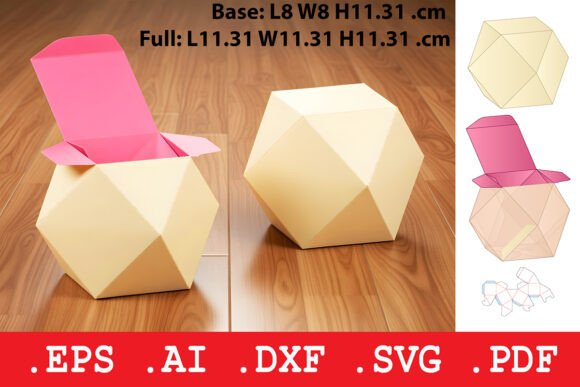
In the competitive landscape of product packaging, the moment a customer interacts with a box is just as critical as the product inside. Standard cubic containers have their place in logistics, but they rarely inspire wonder. The Rhombic Dodecahedron Folding Box challenges this norm by offering a geometrically complex yet functionally simple solution for premium presentation. This template transforms flat sheet material into a twelve-faced polyhedron that serves as both protective vessel and tactile experience. Unlike traditional packaging that relies heavily on adhesives and tape, this design utilizes an interlocking fold system to create a self-supporting structure that feels substantial in the hand.
For designers, makers, and brands looking to differentiate their physical touchpoints, understanding the mechanics and applications of this specific geometric form is essential. It bridges the gap between mathematical precision and practical utility, providing a canvas for creativity that standard die-cut boxes simply cannot offer.
Structural Integrity Through Geometric Design
The defining characteristic of the Rhombic Dodecahedron Folding Box is its ability to maintain rigidity without glue. This is not merely an aesthetic choice; it is a structural necessity achieved through precise engineering. The twelve rhombic faces distribute stress evenly across the surface area, creating a shell that resists crushing forces better than many glued cardstock alternatives. When the tabs are folded and locked into their corresponding slots, the tension within the paper itself holds the shape together.
This glue-free assembly offers significant advantages in modern production workflows. Eliminating adhesives removes drying time from the assembly line, allowing for immediate packing and shipping. It also creates a cleaner interior aesthetic, free from glue residue or tape marks that can detract from a luxury unboxing experience. Furthermore, the absence of chemical binders makes the packaging inherently more sustainable and easier to recycle, as there is no need to separate adhesive components from the paper fiber.
The wide opening lid is another crucial functional element. While some geometric packaging sacrifices accessibility for form, this template prioritizes user interaction. The lid mechanism allows for easy insertion and removal of contents, ensuring that the novelty of the shape does not become a frustration for the end-user. This balance of sculptural beauty and ergonomic function is what makes the design viable for commercial use rather than just artistic exploration.
Material Selection and Weight Optimization
Achieving the crisp edges and durable rigidity required for this folding box depends entirely on selecting the correct substrate. The template is specifically optimized for paper weights between 200 and 350 gsm. Understanding why this range matters prevents costly prototyping errors.
- Below 200 gsm: Lighter papers lack the tensile strength to hold the interlocking tabs securely. The folds may appear soft or rounded rather than sharp, and the structure risks collapsing under the weight of even lightweight products.
- 200–250 gsm: This range is ideal for smaller items like jewelry, cosmetics, or confectionery. It offers enough stiffness for clean creases while remaining pliable enough for hand-folding without cracking the fibers.
- 280–350 gsm: Heavier stocks provide maximum durability and a premium, substantial feel. This weight is necessary for larger volumes or heavier products. However, it requires deeper scoring to prevent fiber breakage during assembly.
- Above 350 gsm: Unless using industrial automated creasing equipment, materials thicker than this may be too rigid for the tab-locking mechanism, leading to difficulty in assembly and potential deformation of the rhombic faces.
When working with the Rhombic Dodecahedron Folding Box, the grain direction of the paper should also be considered. Aligning the grain parallel to the primary fold lines can enhance structural integrity and ensure smoother folding. Testing with your specific chosen material before full-scale production is always recommended to verify that the tab tolerances match the thickness of your stock.
Versatile File Formats for Modern Workflows
Digital fabrication has democratized access to complex packaging designs, but only if the files are compatible with available hardware. This template package addresses the fragmented nature of modern making by including five distinct file formats, each serving a specific role in the production ecosystem.
CNC and Laser Cutting Precision
The .DXF (Drawing Exchange Format) file is the industry standard for CNC routers and laser cutters. This format contains pure vector path data without styling information, ensuring that machines interpret cut lines and score lines accurately. For users operating Glowforge, xTool, or industrial CO2 lasers, the DXF ensures that the intricate tab geometry is executed with sub-millimeter precision, which is non-negotiable for friction-fit assemblies.
Digital Design and Craft Cutting
For creators using Cricut, Silhouette, or Brother ScanNCut machines, the .SVG (Scalable Vector Graphics) file provides immediate compatibility. SVGs retain layer information, allowing users to easily assign different operations (cut vs. score) within software like Cricut Design Space or Silhouette Studio. This format is also web-friendly, making it useful for digital mockups or online product listings where visualizing the dieline is necessary.
Professional Print Production
When moving beyond prototyping to branded production runs, the .EPS (Encapsulated PostScript) and .AI (Adobe Illustrator) files become essential. These formats support CMYK color spaces, spot colors, and bleed settings required by commercial print shops. The AI source file allows graphic designers to map artwork directly onto the unfolded net, adjusting branding elements to account for the fold lines. Because the rhombic dodecahedron involves non-orthogonal angles, having the editable vector source ensures that patterns align correctly across the twelve faces when folded.
Manual Assembly and Visualization
The .PDF serves as the universal reference document. It is print-ready for those assembling prototypes on home printers or needing a visual guide for manual cutting. More importantly, it acts as a communication tool between designers and clients who may not have vector software installed, allowing stakeholders to review dimensions and proportions before committing to fabrication.
Strategic Applications in Branding and Gifting
The unique topology of the Rhombic Dodecahedron Folding Box lends itself to specific market niches where perception drives value. Its departure from rectangular norms signals to the consumer that the contents are special.
Luxury Cosmetics and Skincare: Small jars and bottles nestle well within the central cavity. The geometric facets catch light dynamically on retail shelves, creating visual interest that flat surfaces cannot achieve. The sturdy 300+ gsm construction protects glass containers during transit while conveying quality.
Artisan Confectionery: Chocolates, truffles, and macarons benefit from the protective cage-like structure. The wide lid allows customers to view the assortment without fully dismantling the package, encouraging purchase while maintaining hygiene and protection.
Tech Accessories and Novelties: Earbuds, smartwatch bands, or limited-edition collectibles fit the scale perfectly. The tech-forward aesthetic of the polyhedron aligns well with innovation-focused brands, reinforcing the product's modern identity through packaging architecture.
Event Favors and Corporate Gifts: For weddings or conferences, these boxes serve as memorable keepsakes. Their interactive assembly can even be part of the guest experience, turning packaging into an activity. Because they ship flat and assemble without tools, they are logistically efficient for event planners managing large quantities.
Practical Considerations for Implementation
While the Rhombic Dodecahedron Folding Box offers numerous benefits, successful implementation requires attention to detail. Scoring depth is paramount; insufficient scoring leads to cracked paper on the outside of folds, while excessive scoring cuts through the material entirely. For laser users, this means calibrating power and speed settings specifically for scoring versus cutting. For manual assembly, using a bone folder with appropriate pressure ensures professional results.
Storage and shipping efficiency are additional factors. Despite its voluminous assembled shape, the template packs completely flat. This reduces warehousing costs and carbon footprint compared to pre-assembled rigid boxes. However, because assembly is manual, labor time must be factored into the cost model. For high-volume runs, investing in automated creasing and folding equipment may be justified, whereas small batches remain perfectly suited for hand assembly.
Ultimately, choosing this packaging solution is a commitment to craftsmanship. It demands more effort than taping a standard mailer, but the return on investment comes in the form of brand differentiation and customer delight. By leveraging the provided vector files and adhering to material specifications, creators can harness the elegance of rhombic geometry to transform ordinary products into extraordinary experiences.