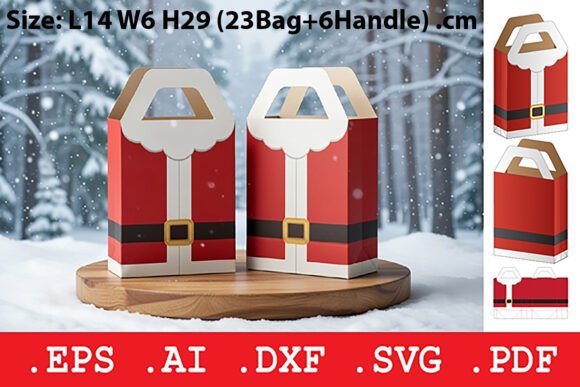
Santa Suit Christmas Gable Bag Design Template
Holiday packaging often struggles to balance festive charm with structural integrity. The Santa Suit Christmas Gable Bag template solves this specific design challenge by merging a recognizable seasonal silhouette with functional engineering. Unlike standard rectangular gift boxes or flimsy paper sacks, this template utilizes the iconic shape of Santa’s coat to create an integrated carry handle and reinforced base. For designers and small business owners producing holiday goods, this isn't just a decorative container; it is a strategic branding asset that communicates quality and attention to detail before the recipient even opens the package.
The visual personality of this gable bag leans into nostalgic warmth without sacrificing modern production standards. The diecut lines are precise, allowing for crisp folds that maintain the suit’s proportions even when loaded with 200–350 gsm paper stock. This weight range is critical. Lighter papers fail to support the non-rigid structure, causing the "suit" to sag, while heavier cardstocks may crack along fold lines or jam automated finishing equipment. When executed correctly on appropriate stock, the bag offers a tactile experience that elevates simple treats like cookies, candies, or jewelry into premium gifts. The fold-over top closure creates security during transport, addressing a common pain point in DIY holiday packaging where contents frequently spill.
Strategic Applications in Holiday Branding and Retail
While typography choices like a script font or handwritten font set the tone for holiday messaging, the physical vessel carrying that message dictates perceived value. This template serves as a high-impact touchpoint for various commercial and creative projects. Bakeries and confectioners benefit most from the structural stability, as the reinforced bottom supports dense items without buckling. For retail brands, the Santa Suit Christmas Gable Bag functions as mobile advertising. Customers carrying these distinctive bags become brand ambassadors, spreading visual recognition through shopping districts and social media posts far more effectively than generic white boxes.
In editorial and content creation contexts, this packaging template provides essential visual texture. Bloggers and influencers photographing holiday guides need props that read clearly at thumbnail size. The distinct silhouette of the Santa suit creates immediate visual hierarchy in flat lays and lifestyle shots, distinguishing your content from competitors using standard packaging. Publishers creating holiday kits or subscription boxes can utilize this format to enhance unboxing experiences. The novelty factor encourages user-generated content, extending the reach of your brand identity organically. Because the template includes vector files, marketing teams can easily adapt the surface graphics to match seasonal campaigns without redesigning the structural dieline each year.
Technical File Formats for Professional Production
Versatility across different manufacturing workflows is what separates a hobbyist craft file from a professional design asset. This template package includes five distinct formats, each serving a specific role in the production pipeline. Understanding when to use each ensures color accuracy, cut precision, and efficient workflow management.
- .DXF (Drawing Exchange Format): Essential for CNC routers and industrial laser cutting hardware. This format strips away styling data to provide pure geometric paths, ensuring machines interpret cut lines versus score lines accurately without software translation errors.
- .SVG (Scalable Vector Graphics): The standard for digital craft cutters like Cricut or Silhouette. SVGs retain layer information and scale infinitely without pixelation, making them ideal for prototyping or small-batch home production.
- .EPS (Encapsulated PostScript): Required for commercial offset printing and large-format signage. EPS preserves vector integrity across different RIP software, preventing font substitution or line weight changes during industrial print runs.
- .PDF (Portable Document Format): Serves dual purposes as a print-ready proof for manual assembly and a universal viewing file for client approvals. It locks dimensions to prevent accidental scaling during handoff.
- .AI (Adobe Illustrator): The master source file allowing full customization of bleed areas, registration marks, and structural modifications. This is necessary if you need to adjust tab sizes for different paper thicknesses or integrate custom window cutouts.
Material Selection and Structural Integrity
The success of the Santa Suit Christmas Gable Bag depends entirely on matching the substrate to the engineering specifications. The recommended 200–350 gsm range exists because the design relies on paper tension rather than adhesive rigidity. Within this spectrum, material choice influences both aesthetics and function. Uncoated matte stocks absorb ink deeply, enhancing the cozy, traditional feel suitable for artisanal goods. However, they offer less moisture resistance, which matters if packaging oily treats or fresh baked goods. Conversely, coated or glossy stocks provide vibrant color reproduction and protection but can appear too commercial for heritage brands.
Grain direction is another technical consideration often overlooked in packaging design. For this specific gable style, the grain should run parallel to the primary vertical folds. Folding against the grain weakens the fiber structure, leading to unsightly cracking on dark-colored papers and reducing the load-bearing capacity of the handle. Testing prototypes on your chosen stock before mass production is non-negotiable. A 300 gsm linen-textured paper might look beautiful but could be too stiff for the intricate handle mechanism, whereas a smooth 250 gsm cover stock might offer the perfect balance of drape and strength. Always verify that your printer’s scoring blades are adjusted for your specific caliper to ensure clean, professional folds.
Customization and Visual Hierarchy
Owning the .AI source file transforms this template from a static product into a flexible component of your broader creative font and graphic strategy. Effective customization goes beyond slapping a logo on the front panel. Consider how the Santa suit shape interacts with your typographic choices. A bold display font placed on the lower torso area anchors the design visually, mimicking the weight distribution of the actual suit. Delicate serif fonts work better on the upper chest or collar areas where space is constrained. Avoid placing critical text near fold lines or glue tabs, as distortion during assembly will compromise readability.
Color psychology also plays a significant role. While red and white are traditional, alternative palettes can differentiate your brand in a saturated market. Deep greens, navy blues, or metallic golds applied to this familiar silhouette create cognitive dissonance that captures attention. For minimalists, leaving the suit unprinted on natural kraft paper allows the form itself to serve as the decoration, with branding relegated to a belly band or sticker. This approach reduces ink costs and appeals to eco-conscious consumers. Remember that the integrated handle is prime real estate; adding a subtle pattern or brand color to the interior of the handle creates a delightful surprise moment during use that reinforces brand recall.
Evaluating Fit for Commercial Projects
Before committing to this template for a large campaign, assess its alignment with your operational capabilities and audience expectations. The Santa Suit Christmas Gable Bag excels in scenarios where presentation equals value. It is less suitable for shipping directly via postal services without additional outer packaging, as the non-rigid structure requires protection from crushing. If your primary distribution channel is e-commerce fulfillment centers, test how the bag performs inside mailers first.
Licensing and scalability should also factor into your decision. Ensure your license covers the intended volume of reproduction, especially if moving from hand-assembled boutique batches to automated factory production. From a design consistency standpoint, this template pairs exceptionally well with other die-cut holiday assets like tags or ornaments that share similar corner radii or line weights. Building a cohesive system of design assets around this central packaging piece strengthens overall brand perception. Ultimately, the best packaging doesn't just hold a product; it extends the narrative of the brand. By treating this gable bag as a canvas for strategic storytelling rather than mere containment, you transform a seasonal necessity into a memorable brand interaction.